
Montecito Facelift: How Deep Plane and DeepFrame Techniques Compare

Picking a facelift technique can feel like picking between three names for the same thing. Deep plane, SMAS, DeepFrame. They sound alike, and they are not. If you live in Montecito and want a face lift close to home, this guide explains what each one does, what the research says, and what to ask before you decide.
The short answer: A facelift lifts the deeper tissue that has slipped and then lays the skin back without strain. A deep plane facelift frees that tissue and moves it as one unit. The DeepFrame Facelift is Dr. Lowenstein's version, and it lifts in several directions at once. Both suit people with jowls, deep smile lines, and a softer neck.
Dr. Adam Lowenstein is a board-certified plastic surgeon, certified by the American Board of Plastic Surgery, and a Fellow of the American College of Surgeons (FACS). He created the DeepFrame Facelift and wrote a book about the technique. Montecito Plastic Surgery is at 1722 State Street, Suite 101, in Santa Barbara, next door to Montecito.
Key facts
A 2026 review of 45 studies and 10,784 deep plane patients found an overall complication rate of 6.6% and no permanent facial nerve injury [1].
Temporary facial nerve weakness occurred in about 1.2% of patients, and hematoma (a collection of blood under the skin) in about 1.8% [1].
A 2019 review of 183 studies found no difference in permanent nerve injury between techniques. Its authors say technique should be chosen on the quality of the result [2].
A 2025 review found similar safety for SMAS and deep techniques and called for individual planning [3].
Smoking is linked to skin healing problems after a facelift [4].
Anyone can check a surgeon's board certification for free on the American Board of Plastic Surgery site [5].
What is a facelift, and who considers one in Montecito?
A facelift (rhytidectomy) repositions the deeper tissue of the cheeks, jawline, and neck, then redrapes the skin. It targets sagging cheeks, jowls, deep folds beside the nose and mouth, and loose or banded neck tissue. Most patients are in their 40s, 50s, or 60s, though age matters less than anatomy and goals.
The face ages in layers. Skin loses spring. Fat pads slide down. The muscle sheet beneath them loosens. Fillers and Botox can soften the surface, but they do not move tissue back where it belongs. A facelift does.
The goal of a good Montecito facelift is simple: you look like yourself, only rested. That goal shapes everything below. If you are weighing surgery against injectables, our guide to the facelift procedure is a good first read. For a broader tour of every facelift type, see facelift types, recovery, and choosing a surgeon.
How does a deep plane facelift differ from a SMAS facelift?
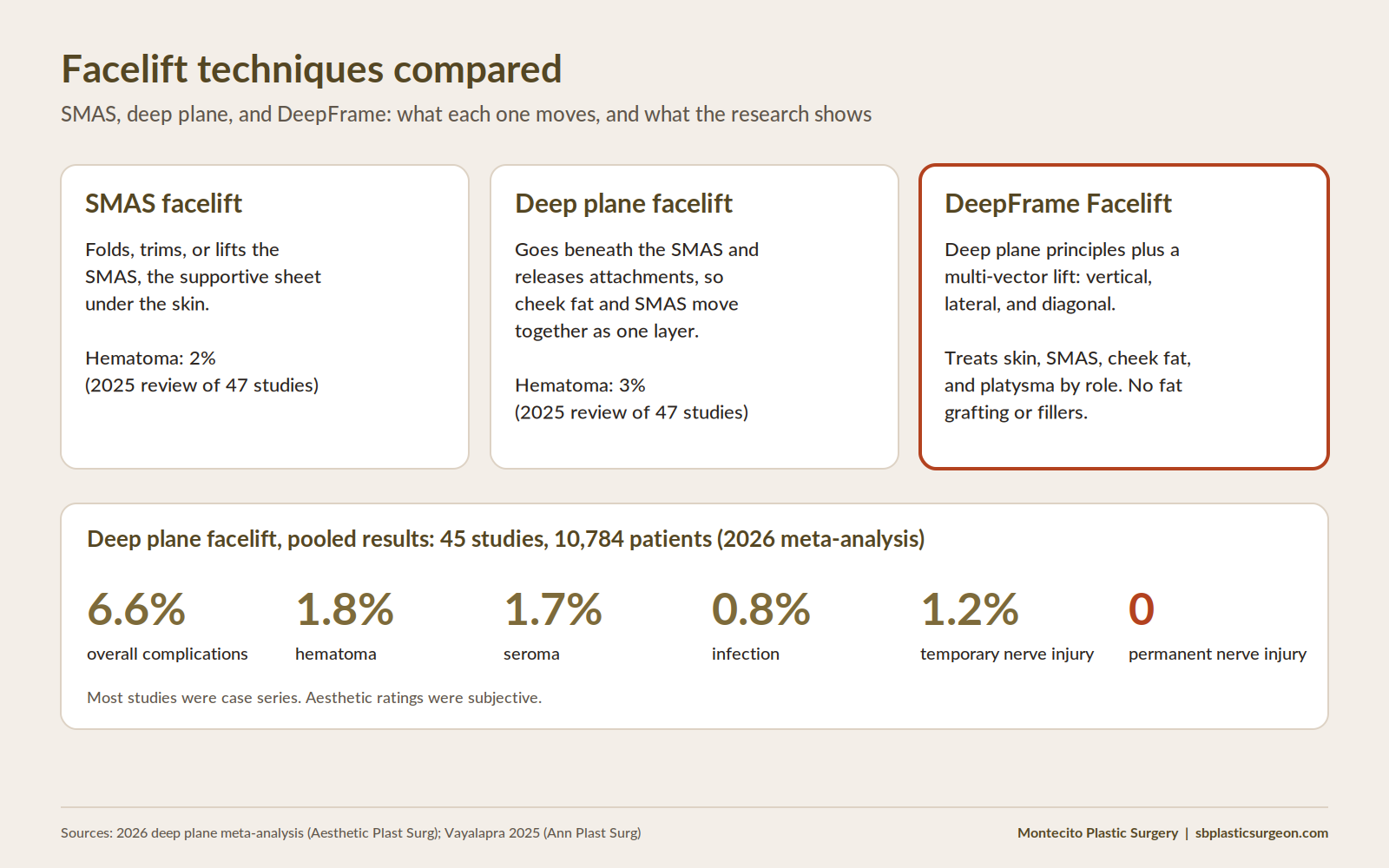
The SMAS (superficial musculoaponeurotic system) is the tough sheet of tissue under your skin that holds the cheeks and jaw in place. A SMAS facelift folds, trims, or lifts that sheet. A deep plane facelift goes beneath it and releases the attachments, so the cheek fat and SMAS move together as one layer.
Which one carries less risk? The research says the gap is small. A 2019 meta-analysis of 183 studies found that permanent nerve injury did not differ between techniques. Major hematoma ran slightly higher with deep plane (1.22%). The authors concluded that technique should be chosen for the result, not the complication profile [2].
A 2025 review of 47 studies and 10,766 patients agreed. Hematoma was 3% for deep techniques and 2% for SMAS techniques. Nerve injuries were similar, mostly temporary, and rarely permanent. Only one study compared midface results head to head, and it favored the deep approach. The authors still called for plans tailored to each patient [3].
Here is what that means for you. Neither technique is a wrong answer. Dr. Lowenstein's view is that skill matters as much as the label. A surgeon who has mastered the SMAS can match the result of one who has mastered the deep plane. The direction of tension on the tissue matters just as much as the plane of dissection. We cover that in more detail in deep plane vs. SMAS facelift.
What makes the DeepFrame Facelift different?
The DeepFrame Facelift builds on deep plane principles and adds a multi-vector lift. Instead of pulling in one direction, it repositions tissue vertically, sideways, and diagonally, based on where gravity moved volume in your face. Each layer is treated for its own role: skin, SMAS, deep cheek fat, and the neck muscle (platysma).
Dr. Lowenstein tailors the SMAS to your face shape. A narrow face may need folding for volume. A fuller face may do better with trimming so it does not look rounder. The neck muscle may be divided, retracted, or reshaped, depending on where bands or fullness sit. The skin is then draped back without pulling, because tension at the surface is what creates the tight, stretched look.
This approach also avoids fat grafting and fillers. The aim is to return your own tissue to where it used to sit. Patients who want the technical detail can read the DeepFrame technique page or the full DeepFrame Facelift overview. Our comparison of DeepFrame and traditional deep plane surgery walks through the differences step by step.
What should Montecito deep plane facelift patients know about safety?
Every facelift carries risk, and the numbers are low. In the largest pooled look at deep plane surgery, 45 studies covered 10,784 patients. The overall complication rate was 6.6%. Hematoma was 1.8%, seroma (fluid under the skin) 1.7%, and infection 0.8%. Temporary nerve weakness was 1.2%, and no permanent facial nerve injury was seen [1].
Two cautions come with those numbers. Most of the studies were case series, not randomized trials. And the "better looking" ratings were subjective. The authors say randomized studies and long-term follow-up are still needed [1].
Hematoma is the complication surgeons guard against most. It is the most common reason a facelift patient returns to the operating room. High blood pressure is the biggest modifiable risk factor, along with some medications and supplements [6]. That is why a good consultation covers your medical history, your blood pressure, and everything you take, from aspirin to fish oil.
Smoking matters too. A classic study of facelift patients linked a significant share of skin sloughs after surgery to cigarette smoking [4]. If you smoke or vape nicotine, tell us early. Plan to stop nicotine well before surgery. We will give you exact timing at your consultation.
Where and how you have surgery also matters. Dr. Lowenstein operates at an AAAASF-accredited surgery center. The American Society of Plastic Surgeons explains that accredited facilities must meet national standards for equipment, personnel, and emergency plans [7].
How long is recovery after a facelift?
Most deep plane facelift patients return to social activities in 10 to 14 days. Bruising and swelling are heaviest in the first few days, then fade through weeks two to four. Tissue keeps settling for months, and your final result is best judged at about one year. Your own pace depends on age, health, and habits.
Here is a rough picture:
Days 1 to 3: Swelling peaks. You rest with your head raised.
Days 4 to 7: Bruising shifts toward the neck as it clears.
Weeks 2 to 4: Most visible bruising is gone. Makeup helps.
Months 2 to 6: Contours soften and sharpen. Sensation returns.
Because Montecito is next door to our Santa Barbara office, follow-up visits are a short drive. That helps in the first week, when check-ins matter most. Our facelift recovery timeline covers each stage, including what to eat, how to sleep, and when to return to exercise.
Many patients ask how long results last. Everyone ages differently, but many patients enjoy a deep plane result for 8 to 12 years or more. No facelift stops aging. It moves the clock back, and aging continues from the new starting point.
 Facelift by Dr. Lowenstein. Individual results vary.
How do you find the best facelift surgeon near Montecito?
Many patients start with that search. A fair way to answer it is to check facts you can verify. Look for certification by the American Board of Plastic Surgery, an accredited operating facility, and plenty of before-and-after photos of patients who resemble you. Then meet in person and see whether the plan makes sense to you.
Board certification is a voluntary credential. The American Board of Plastic Surgery says its diplomates completed approved training and passed written and oral exams covering all of plastic surgery [5]. You can confirm any surgeon's status in a few minutes on the board's lookup page.
Next, ask who gives the anesthesia and where surgery happens. The ASPS guide notes that accredited facilities use a board-certified anesthesiologist or a certified nurse anesthetist [7]. At Montecito Plastic Surgery, anesthesia is provided by a nurse anesthetist or a local physician anesthesiologist.
Finally, look at the photos. Our facelift gallery shows front and side views, so you can judge the look we aim for: natural, balanced, and still you.
Considering this? See DeepFrame Facelift in Santa Barbara, deep plane facelift, and facelift before-and-after photos.
Questions to bring to your consultation
Which technique do you recommend for my face, and why?
How many facelifts like mine do you perform in a year?
Where will surgery take place, and is the facility accredited?
Who will provide my anesthesia?
How do you manage blood pressure before, during, and after surgery?
What will recovery look like for me in week one, week four, and month three?
Can I see photos of patients with a similar face and age?
Would a neck lift or eyelid surgery fit into my plan?
Frequently asked questions
Is there a Santa Barbara facelift surgeon near Montecito?
Yes. Montecito Plastic Surgery is at 1722 State Street, Suite 101, Santa Barbara, CA 93101, next door to Montecito. Dr. Lowenstein is a board-certified plastic surgeon who created the DeepFrame Facelift. You can book a consultation by calling 805-969-9004.
Will a deep plane facelift make me look different?
The goal is the opposite. Deep plane and DeepFrame surgery reposition your own tissue, so the face keeps its shape and expression. Patients often tell us they look like themselves again. Your consultation includes a look at your anatomy and a clear picture of what to expect.
Can I combine a facelift with a neck lift?
Often, yes. The neck muscle is part of the deeper support system, so many facelifts already include neck work. Some patients add a separate neck lift for more definition under the chin. Combined procedures lengthen surgery, so we review the plan with you in detail.
Does smoking affect facelift healing?
It can. Cigarette smoking has been linked to skin sloughs after facelift surgery [4]. A 2018 meta-analysis found a higher odds ratio for complications after facelifts in people with a smoking history (3.36), though the result was not statistically significant [8]. Because nicotine slows healing, plan to stop well before surgery.
Is a Montecito facelift covered by insurance?
No. A facelift is elective cosmetic surgery, so insurance does not cover it. We provide a written quote after your consultation. Our team can also walk you through financing options.
Ready to talk about your face lift in Montecito?
Meet with Dr. Lowenstein to review your goals, your anatomy, and the technique that fits you. Visit us at 1722 State Street, Suite 101, Santa Barbara, CA 93101. Call 805-969-9004 or contact us online. Browse the facelift gallery first if you like, and ask about financing.
Sources
Deep plane facelifts: a systematic review and meta-analysis of outcomes. Aesthetic Plastic Surgery. 2026.
Jacono AA, Alemi AS, Russell JL. A meta-analysis of complication rates among different SMAS facelift techniques. Aesthetic Surgery Journal. 2019.
Vayalapra S, Guerero DN, Sandhu V, et al. Comparing the safety and efficacy of superficial musculoaponeurotic system and deep plane facelift techniques: a systematic review and meta-analysis. Annals of Plastic Surgery. 2025.
Rees TD, Liverett DM, Guy CL. The effect of cigarette smoking on skin-flap survival in the face lift patient. Plastic and Reconstructive Surgery. 1984.
American Board of Plastic Surgery. Is your surgeon certified?
How to prevent and treat complications in facelift surgery. Aesthetic Surgery Journal Open Forum. 2021.
American Society of Plastic Surgeons. Accredited facilities.
Theocharidis V, Katsaros I, Sgouromallis E, et al. Current evidence on the role of smoking in plastic surgery elective procedures: a systematic review and meta-analysis. Journal of Plastic, Reconstructive & Aesthetic Surgery. 2018.
This article is for educational purposes and isn't a substitute for an individual medical evaluation. Individual results vary.